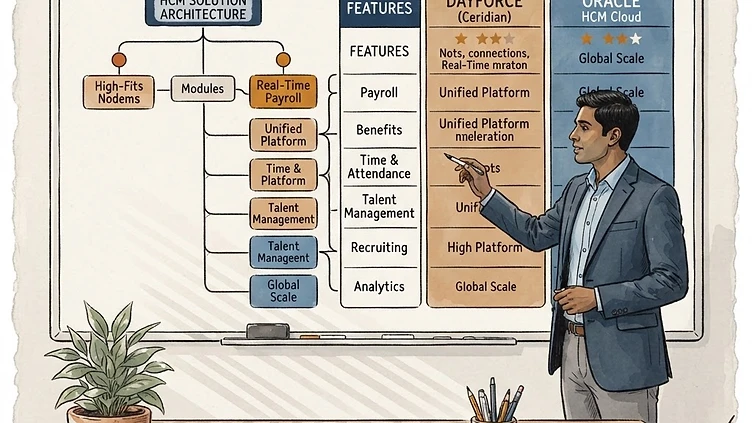
Oracle HCM Cloud is not a mid-market product pretending to be one. It is an enterprise platform that mid-market companies sometimes end up on, and the distinction matters more than most buyers realize at contract signature. When a 600-person manufacturer or a 1,200-employee healthcare company evaluates Oracle HCM Cloud against Dayforce, the architectural differences, licensing complexity, and implementation demands create a decision that looks like an enterprise comparison but actually has a clear winner in the mid-market range.
Oracle HCM Cloud: enterprise heritage, mid-market reality
Oracle HCM Cloud is the product of deliberate enterprise positioning. Oracle acquired PeopleSoft in 2004 and Taleo in 2012, then built a cloud-native HCM suite on top of that heritage. The result is a platform with genuine depth for large, complex organizations — and a licensing, implementation, and support model that reflects that positioning.
Oracle HCM Cloud user ratings in the mid-market range (500–2,500 employees) average 7.4 out of 10, with 79% of users willing to recommend. Compare that to Dayforce: 8.2 out of 10, 89% recommend rate. The satisfaction gap is a product of the mid-market fit gap.
The reason mid-market Oracle implementations underperform on satisfaction is structural: Oracle sells and supports the product at an enterprise tier, even when the buyer is mid-market. Configuration support, implementation partner availability, and ongoing account management reflect a product designed for large deals with long cycles — not the agile mid-market buyer who needs fast time-to-value and responsive support.
Architecture: unified platform vs. acquired modular stack
Dayforce runs on a single-database architecture that combines HR, payroll, time management, benefits, and workforce analytics in one continuously-calculated data store. Every data element — a punch, a rate change, an absence entry, a benefits election — immediately propagates through the entire system.
Oracle HCM Cloud is a modular suite built on products Oracle acquired and integrated over time. The core HR module is functionally capable, but the payroll engine — particularly for U.S. mid-market deployments — relies on Oracle Payroll or a third-party integration. The integration model is mature, but it's not architecturally unified in the way Dayforce is.
Payroll depth: where the mid-market gap becomes operational
Oracle's payroll heritage runs deep — the Oracle payroll engine handles complex enterprise payroll for large organizations. For global organizations with multi-country legal entity complexity and sophisticated benefits structures, Oracle's payroll depth is genuine.
The mid-market payroll picture is more complicated. Oracle HCM Cloud's U.S. mid-market payroll configuration frequently requires certified Oracle implementation specialists, which narrows the available partner pool and drives up implementation cost. Third-party payroll integrations — with ADP, Ceridian, or others — are common in Oracle mid-market deployments and introduce the same data-exchange complexity that mid-market buyers think they're avoiding by choosing Oracle over simpler products.
Dayforce payroll is native across all 50 U.S. states and all Canadian provinces. The configuration model is designed for mid-market implementation partners who work in the product daily, not enterprise Oracle specialists.
The Forrester ROI counterpoint to Oracle's high TCO. Forrester's Total Economic Impact study for Dayforce found a 176% three-year ROI for organizations replacing legacy HCM systems. The benefits were driven by reduced payroll processing time, eliminated manual reconciliation between disconnected systems, and lower compliance error costs.
Head-to-head comparison: the key dimensions
Need hands-on help with Dayforce?
Talk to our team →| Dimension | Oracle HCM Cloud | Dayforce | |---|---|---| | Target market | Enterprise (5,000+ employees) | Mid-market (200–5,000 employees) | | Pricing model | Module + user-based; high cost | Per-employee/month; transparent | | Implementation timeline | 12–24+ months (mid-market) | 6–12 months (mid-market) | | User rating (mid-market) | 7.4/10 | 8.2/10 | | Recommend rate | 79% | 89% | | Native payroll (U.S./Canada) | Via Oracle Payroll or 3rd party | Yes, built-in | | Architecture | Modular (acquired products integrated) | Single database, continuous calculation | | Best fit | Large enterprise, Oracle ecosystem | Mid-market 500–5,000 FTE |
Oracle HCM Cloud licensing: where the cost hides
Oracle's pricing model is module-based, user-based, and tiered. The final per-employee cost depends on which modules are licensed, the contract tier, and negotiating position. Mid-market companies consistently report that the license quote at renewal doesn't match the per-employee cost they expected when signing.
Beyond license cost, Oracle's implementation and ongoing support model adds significant overhead: certified Oracle implementation partners charge higher hourly rates than mid-market Dayforce specialists; Oracle's support tiers reflect enterprise SLA expectations; and the internal HRIS capacity required to manage a modular Oracle configuration at mid-market scale is higher than the comparable Dayforce requirement.
The Oracle ecosystem trap
Mid-market companies often end up on Oracle HCM Cloud through acquisition — they acquired a company that was already on Oracle, or they selected Oracle as part of a broader ERP evaluation where the HCM decision followed the ERP decision. The Oracle ecosystem dependency that keeps companies on Oracle is the same dynamic that keeps companies on SAP: the integration work is real, but it's often framed as more prohibitive than it actually is.
Dayforce has mature integration templates for common ERP systems including Oracle EBS, NetSuite, and SAP. Mid-market companies have executed Oracle-to-Dayforce migrations with functioning Oracle ERP integrations intact.
Where Dayforce wins for mid-market
- Architecture. Single database, continuous calculation, real-time payroll visibility.
- Implementation speed. 6–12 months vs 12–24+ months for comparable scope.
- Total cost. Significantly lower over three years due to faster implementation, fewer internal staff, and no third-party payroll add-on.
- Native payroll. All U.S. states and Canadian provinces without third-party add-ons.
- User satisfaction. 8.2/10 vs 7.4/10, 89% recommend rate vs 79%.
Where Oracle HCM Cloud wins
- Enterprise scale. Multi-country, multi-currency, multi-language at global enterprise scale.
- Oracle ecosystem. If your ERP is Oracle EBS, NetSuite, or Fusion, the integration is native.
- Talent management. Recruiting (Taleo heritage), performance, learning, and succession.
- Global analytics. Cross-domain reporting and analytics for global enterprises.
The bottom line for mid-market buyers
For companies in the 500–5,000 employee range, Dayforce is the stronger choice in most head-to-head evaluations with Oracle HCM Cloud. The architectural, cost, implementation speed, and user satisfaction advantages are structural. Oracle HCM Cloud is the right choice for large enterprises with global operations, Oracle ERP ecosystems, or where talent management is the primary HCM driver. If you're mid-market and on Oracle HCM Cloud because of an acquisition or an ERP-bundled decision, the migration to Dayforce is more feasible than Oracle's renewal quotes imply.
Struggling with Dayforce Consulting?
Harmon & Co specializes in Dayforce consulting for mid-market companies. We fix it the first time — no endless ticket queue, no generic advice.