ADP is the default choice in mid-market HCM. When an HR director starts evaluating alternatives, ADP is usually already in the conversation — not because it was selected, but because it's the baseline. The question isn't "should we consider ADP?" It's "why are we still paying for it, and what would it cost to actually fix the problems we've been living with?"
This comparison is for companies with 200–5,000 employees that are currently on ADP or evaluating it against Dayforce. The ADP product is genuinely functional — it's not a bad system. The problem is that "functional" at the mid-market level often means "support tickets that never get answered, configuration gaps that cost thousands in payroll errors, and a renewal quote that increases every year without corresponding value."
Why ADP has a mid-market reputation problem
ADP's product portfolio is wide. For enterprise companies (5,000+ employees), ADP RUN and ADP Workforce Now are mature platforms with strong support infrastructure. For mid-market companies — the 200–5,000 employee range — the story is different, and the reasons are structural.
ADP's mid-market support model is oriented toward high-volume, low-complexity clients. When you have a configuration question, a payroll issue, or a compliance concern, the response times and resolution quality reflect a product design that optimizes for throughput over depth. This is rational from ADP's business perspective: a 300-person company generates less revenue than a 3,000-person company, so it gets proportionally less support investment.
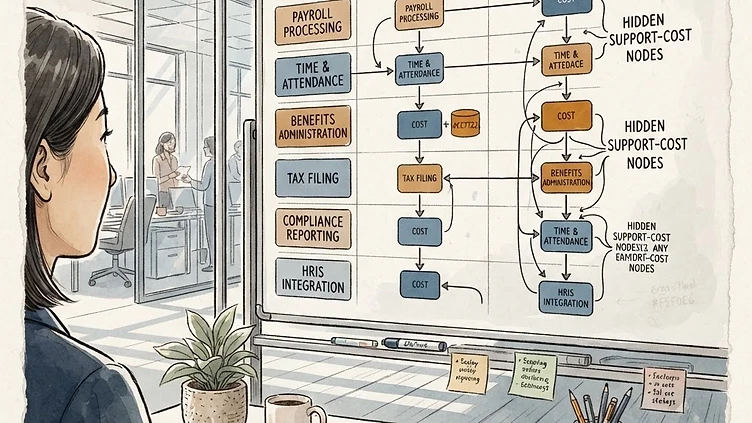
The second structural problem is configuration flexibility. ADP's mid-market products are relatively rigid compared to Dayforce. Complex overtime rules, multi-state compliance scenarios, shift-differential configurations, and nuanced absence management require either expensive custom development or workarounds that introduce risk. Companies on ADP often develop workaround processes — spreadsheets, manual checks, HR manager overlays — that exist solely because the system can't handle the complexity. Every one of those workarounds is a hidden cost.
Architecture: real-time vs batch processing
The architectural difference between ADP and Dayforce is the most concrete point of comparison. ADP's mid-market products process payroll on a batch cycle — calculations run during a defined payroll window, and live payroll preview during the pay period is limited. When an HR manager wants to know what gross payroll looks like today, they're either running a preliminary calculation or waiting until the batch window opens.
Dayforce runs on a continuous calculation model. The payroll engine calculates in real time — every punch, every rate change, every absence entry immediately affects the running payroll total. This means HR managers can see accurate payroll liability at any point in the pay period, not just at the close. For companies with complex compensation structures — overtime, bonuses, deductions, garnishment overrides — this visibility is a meaningful operational advantage, not a cosmetic one.
The practical difference surfaces during mid-payroll-period rate changes. Under ADP's batch model, a rate change made on Wednesday (mid-pay period) requires either a manual adjustment or waiting until the next pay cycle. Under Dayforce's continuous calculation, the change flows through immediately and the payroll preview updates in real time.
Payroll depth and compliance coverage
ADP has deep U.S. payroll coverage — the platform handles all 50 states natively and has strong tax filing infrastructure. This is not ADP's weakness. The compliance depth comparison becomes more nuanced when you factor in global payroll requirements and the support model for compliance questions.
Dayforce's payroll engine covers all 50 U.S. states and all Canadian provinces natively. The real-time compliance update model means regulatory changes (tax rate updates, minimum wage changes, garnishment rule changes) propagate through the system without manual intervention in the same way ADP's model requires.
The migration cost reality: what ADP customers actually spend. If you're currently on ADP and evaluating Dayforce, the migration cost question is often the reason companies stay. Here's the honest data: a Dayforce implementation for a 500-employee company typically runs $150,000–$350,000 over 5–9 months with a dedicated mid-market partner. ADP enhancement projects to address the same configuration gaps typically quote $40,000–$120,000 and take 6–12 months — and they address configuration, not architecture. If your ADP system is generating recurring payroll errors, compliance exposure, or support tickets that go unresolved, the migration pays back in 18–24 months based on error-reduction and support-cost savings alone.
Need hands-on help with Dayforce?
Talk to our team →Total cost of ownership: the three-year view
| Cost Component | ADP (500 EEs) | Dayforce (500 EEs) | |---|---|---| | Annual license (3-yr avg) | $144,000–$216,000 | $162,000–$225,000 | | Implementation | $40,000–$120,000 | $150,000–$350,000 | | Internal HRIS staffing | 1–2 FTE (workarounds) | 0.5–1 FTE (system handles complexity) | | Annual support / add-ons | $15,000–$40,000 | Included | | Payroll error remediation (annual est.) | $20,000–$60,000 | $3,000–$8,000 |
The ADP total looks lower on license cost alone — and it is, by roughly $18,000–$27,000 per year on average. But the implementation gap is smaller than it appears when you account for internal staffing costs, support add-ons, and error remediation. A company spending $30,000–$50,000 annually on ADP-related workarounds and error corrections is effectively paying for a second HR system on top of the license.
Workforce management for hourly workforces
For mid-market companies with significant hourly headcount — manufacturing, healthcare, hospitality, distribution — time and attendance isn't a secondary module. It's the operational backbone.
ADP's time and attendance products are functional but sit outside the core payroll engine for mid-market configurations. This creates the same integration-gap risk that plagues mid-market HCM broadly: time entries need to export, the export needs to match what payroll expects, and discrepancies need to be caught before processing.
Dayforce's time and attendance module is native to the same database as payroll. A punch is immediately available to the payroll calculation engine. Work rules, overtime calculations, shift differentials, and accrual tracking all integrate at the data level rather than the integration level. For companies with complex scheduling — multi-tier overtime, floating holidays, state-specific overtime rules — this architectural difference is the difference between a five-minute pay period close and a three-hour one.
When to migrate and when to optimize
The ADP to Dayforce migration isn't right for every mid-market company. The decision framework is simpler than vendor sales teams make it:
Migrate if: Your ADP system is generating recurring payroll errors that cost real money (estimate: if your ADP errors cost more than 20 hours of HR time per pay period, you're spending $25,000–$60,000 annually on workarounds); your support tickets consistently take more than 48 hours to resolve; your compliance exposure is growing because configuration gaps can't be closed within ADP's model; your renewal quote increased more than 8% year-over-year.
Optimize within ADP if: Your current system runs correctly with manageable workarounds; your HR team has the bandwidth to address configuration gaps incrementally; your compliance exposure is low (single state, straightforward workforce profile); your implementation capacity is limited.
The bottom line for mid-market buyers
For companies in the 200–5,000 employee range currently on ADP, Dayforce represents a meaningful upgrade in architecture, payroll depth, and total cost of ownership over a three-year horizon. The migration is not right for every company — but if your ADP system is generating recurring errors, support is unresponsive, and your renewal quote keeps climbing, the migration pays back faster than the license comparison suggests. If you're actively evaluating the ADP to Dayforce migration, reach out for a scoped conversation — we'll tell you honestly whether the migration makes sense for your specific situation and workforce profile.
Struggling with Dayforce Consulting?
Harmon & Co specializes in Dayforce consulting for mid-market companies. We fix it the first time — no endless ticket queue, no generic advice.