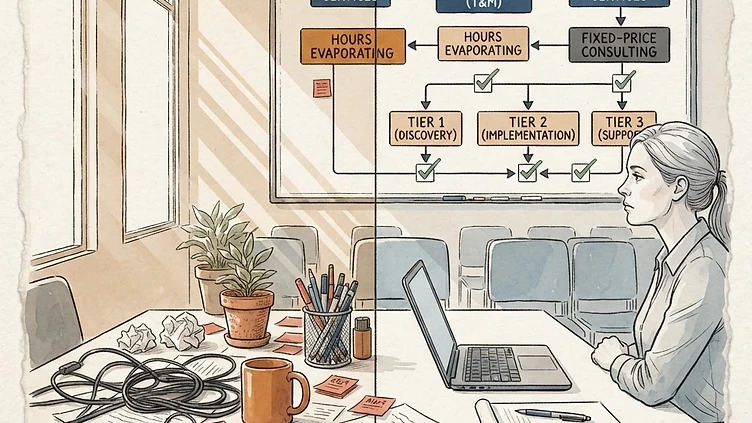
For mid-market companies evaluating Dayforce Professional Services (PS) or Value-Added Services (VAS), the pricing model is the single most consequential factor in the total cost of an implementation — and it is the factor that mid-market buyers consistently underestimate. Both PS and VAS are typically contracted as time-and-materials engagements: the partner bills hours, the buyer pays for hours, and the hours scope is defined at proposal time against a defined statement of work. The mechanics look reasonable on paper. The reality for 200 to 5,000 employee mid-market projects is that PS/VAS hours erode in predictable places — scope drift, slow turnaround cycles, after-hours support windows — and the buyer is on the hook for every hour whether or not the corresponding work produces forward progress on the go-live. The fixed-price consulting alternative is increasingly what mid-market teams use to bring the same work in on a predictable budget.
How Dayforce ships Professional Services and VAS in the mid-market segment
Dayforce (formerly Ceridian) has historically shipped implementation services through two parallel channels: a direct PS organization staffed by Dayforce employees, and a network of certified implementation partners who carry their own PS contracts with the customer and bill against an approved Dayforce SOW template. Both operate primarily on time-and-materials pricing. VAS — Value-Added Services — covers the adjacent work that falls outside a standard implementation: complex integrations the partner isn't staffed to build, custom reporting the customer can't reach through self-service, configuration work the customer's internal team doesn't have capacity for, and ongoing managed services delivered on a monthly hours allotment.
For mid-market companies (200 to 5,000 employees), the PS/VAS combination is usually bundled into a single implementation contract at the start of the project. The customer signs a statement of work that defines the modules in scope, the high-level phase plan, and an estimate range for hours. The estimate is rarely a guarantee — the contract language typically allows the partner to bill against the actual hours worked, with a not-to-exceed figure that is reset through change orders when scope expands. The customer's finance team approves the estimate. The implementation team subsequently works through the phases and tracks hours against the estimate weekly or monthly. Variance flows into one of two places: change orders (if recognized early) or end-of-project overrun (if not surfaced until invoicing).
How Dayforce's PS/VAS cost structure is typically priced
PS and VAS are billed against hourly rate cards that vary by role and by partner. Specialist roles — payroll configuration, integration build, HR module configuration — bill at the highest rates. Project management and oversight roles bill at moderate rates. Junior resources handling bulk data entry or test cycle support bill at the lower end of the rate card. Most mid-market PS contracts blend a team of three to six resources across the implementation, with the mix shifting as the project moves from discovery through go-live.
The shape of the contract matters more than the rate card. Time-and-materials pricing means the customer pays for hours regardless of outcome. A 6-week discovery phase produces a configuration design, but if the partner's discovery output is light — incomplete data audit, vague requirements traceability — the cost of that under-delivery shows up in the next phase as billed rework hours. A 4-week integration phase produces connect/build/test cycles, but if the partner's specialist is also staffed on three other implementations, the cycle runs longer than the SOW assumed. Same hourly rates. Different delivered value.
What most mid-market buyers don't see up front: the largest variable in PS/VAS cost is not the rate card. It is the variance between estimated hours and actual hours worked. That variance is a function of scope definition quality at contract, partner staffing continuity through the engagement, and the customer's internal team readiness. Each of these has a specific shape on the bill. Strong scope definition produces tight variance. Weak scope definition produces 20 to 40 percent overage. Partner staffing discontinuity produces legendarily long resolution cycles. Customer readiness gaps produce "training the trainer" hours that the customer is paying for but not benefiting from.
Where PS/VAS hours tend to evaporate in mid-market engagements
Three patterns show up consistently across mid-market PS/VAS engagements, regardless of which partner carries the contract or which Dayforce modules are in scope. Each one produces billable hours that don't produce equivalent implementation progress.
Scope creep between phases. A discovery SOW that defined 12 integration touchpoints becomes a configuration phase that requires 18 touchpoints. The partner's specialist raises the discrepancy as a billing question rather than a scope correction. Hours flow to integration work that wasn't approved. Same hourly rate. Different scope. Over a 6-month implementation, this pattern alone can move the bill 15 to 25 percent above the original estimate.
Slow turnaround on resolution cycles. A configuration exception is identified during parallel payroll. The specialist is staffed on two other clients during the same window. Response on the exception is delayed by 48 to 72 hours. The error sits in the validation queue, blocking the cycle from closing on schedule. The customer escalates. The cycle eventually closes after multiple back-and-forth rounds — each one billed by the hour. The total hours spent resolving the exception are two to three times what they would have been with single-client focus.
Need hands-on help with Dayforce?
Talk to our team →After-hours support credits that never get used. Mid-market PS contracts often include a small allocation of "after-hours support" hours — a 4-hour block, for example, that the customer can draw on for urgent issues during off-cycle periods. In practice, mid-market teams rarely use this allocation because the activation process requires raising an exception through the partner's ticketing system, and the issue rarely justifies the friction. The allocation becomes a phantom line item — paid but not consumed.
What fixed-price consulting plus hypercare looks like for the same work
The fixed-price consulting model addresses each of the patterns above through a different contract structure. The engagement is scoped to a defined deliverable — configuration of the Benefits module for open enrollment, build of a daily SFTP feed to the benefits carrier, a full ACA compliance audit — and priced against the scope at proposal time. The customer knows the total cost before work starts. If the consultant's hours run long, the cost does not grow. If the work surfaces additional scope, the consultant raises it as a separate proposal rather than running it through change orders against the original SOW.
The hypercare component — the post-go-live window — is the highest-leverage area for fixed-price specialists. Mid-market companies that engage a fractional Dayforce specialist running alongside their internal team for the first 6 to 12 weeks of production operate with the equivalent of having a dedicated partner resource, but without paying for the idle time when there is no exception to resolve. The fixed-price model compresses that into a predictable monthly cost.
The mid-market buyer's decision framework
For mid-market companies evaluating whether to use Dayforce PS/VAS or a fixed-price consulting alternative, the decision comes down to three factors:
-
Scope definition quality. If the SOW is well-defined with clear deliverables and boundaries, PS/VAS time-and-materials pricing can be competitive. If the scope is ambiguous or likely to expand, fixed-price shifts the risk of scope growth to the consultant.
-
Partner staffing model. If the partner guarantees dedicated specialist staffing for the duration of the engagement, PS/VAS hours are more likely to produce value. If the partner staffs the project with shared resources across multiple clients, fixed-price with a specialist who is dedicated to your project is more efficient.
-
Internal team readiness. If the internal team has Dayforce experience and can manage the partner relationship effectively, PS/VAS works. If the internal team is new to Dayforce, the fixed-price model with included knowledge transfer and training is more effective.
For most mid-market companies, the fixed-price model with dedicated hypercare delivers the same implementation work at a lower total cost — not because the rates are lower, but because the hours variance is eliminated and the scope is forced into definition before work begins.
Struggling with Dayforce Consulting?
Harmon & Co specializes in Dayforce consulting for mid-market companies. We fix it the first time — no endless ticket queue, no generic advice.