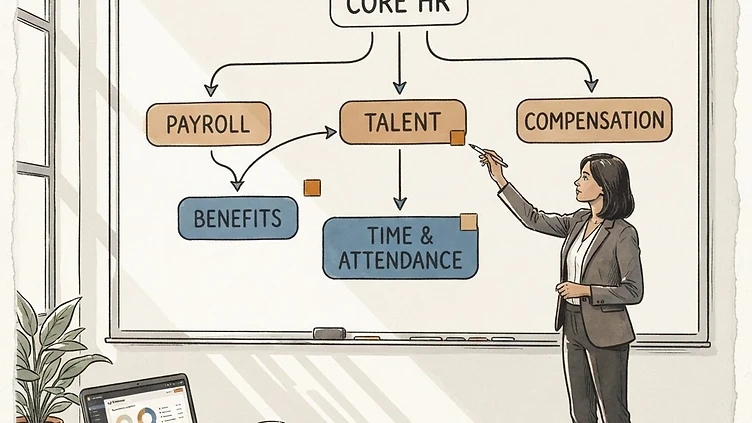
Dayforce is often introduced to a company as a payroll system, then quietly expected to do the work of a full human capital management (HCM) platform. Dayforce HCM consulting is the practice of making Dayforce function as the connected HCM system it was built to be — workforce management, talent, benefits, payroll, and reporting working together rather than as isolated modules.
For mid-market companies, the gap between buying Dayforce and actually using it as an HCM platform is significant. Most implementations deliver payroll and core HR, then stop. The talent, performance, benefits, and workforce modules sit half-configured, and the company runs a patchwork of Dayforce plus spreadsheets plus a legacy ATS. This guide covers what Dayforce HCM consulting involves and how to structure the work so it delivers value rather than another stalled project.
What Dayforce HCM Consulting Covers
Dayforce is a unified platform, but HCM consulting work falls into several distinct areas.
Core HR and position management is the foundation. Org structures, employment types, position hierarchies, and the data model that every other module depends on. If this layer is configured loosely, every downstream module inherits the mess.
Workforce management covers scheduling, time and attendance, and labor rules. This is where Dayforce's unified payroll-and-time model pays off — when it is configured correctly. The configuration complexity here is high, especially for companies with union rules, multiple pay codes, or shift-based operations.
Talent and performance includes recruiting, onboarding, goals, reviews, and compensation. These modules are powerful but frequently left under-configured after go-live because the implementation timeline ran out.
Benefits administration connects carrier integrations, eligibility rules, and enrollment workflows. Done well, it eliminates manual benefit enrollment. Done poorly, it creates a second system of record that disagrees with payroll.
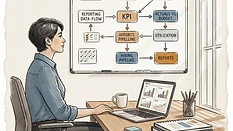
Reporting and analytics is the layer that makes every other module useful. A Dayforce HCM consultant builds the reports leadership actually reads — headcount, turnover, labor cost, comp ratios — rather than leaving the team to rebuild them in Excel every month.
Need hands-on help with Dayforce?
Talk to our team →Why Mid-Market HCM Work Stalls
The pattern is familiar. A mid-market company buys Dayforce to replace a legacy HRIS. The implementation partner scopes payroll, core HR, and a few integrations. Go-live happens, the partner transitions out, and the internal team is left with modules they were trained on but never fully configured.
Then reality sets in. The performance module has no review cycle built. The benefits module isn't connected to carriers. Reporting relies on a handful of saved reports that don't quite answer leadership's questions. The company is paying for an HCM platform but using it as an expensive payroll system.
This is where Dayforce HCM consulting earns its keep — not in a massive reimplementation, but in focused work that turns half-built modules into functioning ones.
How to Structure HCM Consulting Work
The most effective HCM engagements start with an assessment, not a build. A consultant reviews what is configured, what is underused, and what is broken, then prioritizes the work by business value. The output is a short list of focused projects — a performance cycle build, a benefits-to-carrier integration, a reporting overhaul — rather than a vague "optimize Dayforce" engagement.
Each project should be scoped as a fixed deliverable with a defined endpoint. The goal is to leave the internal team with a working module and the knowledge to maintain it, not a dependency on the consultant indefinitely.
The wrong approach is the open-ended retainer with no specific outcomes. Dayforce HCM work is most effective when it is project-based, measurable, and handed off.
Struggling with Dayforce Consulting?
Harmon & Co specializes in Dayforce consulting for mid-market companies. We fix it the first time — no endless ticket queue, no generic advice.