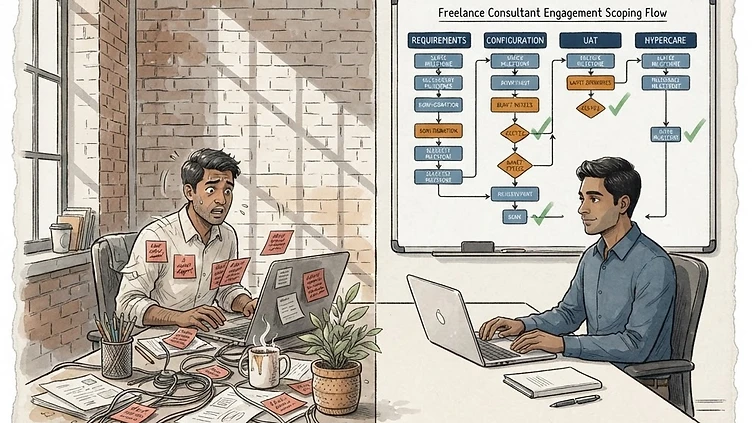
You need a freelance Dayforce configuration specialist for mid-market — not a Big 4 engagement team with a six-month timeline, and not a generalist HR consultant who's worked with Dayforce once. You need someone who can come in, configure specific modules correctly, and leave your team better off than they found them. This guide covers what to look for, how to screen candidates, and why mid-market Dayforce work is genuinely different from enterprise implementations.
The market for Dayforce consultants ranges widely in capability and cost. At one end, large system integrators offer full-service implementations with project managers, configuration specialists, and change management — at a price point built for enterprise budgets. At the other end, generalist HCM consultants with surface-level Dayforce exposure are happy to take your engagement and figure it out as they go. Mid-market companies — typically 200 to 2,500 employees — need something in between: deep product knowledge, hands-on configuration experience, and a commercial model that doesn't require a $500K statement of work.
What mid-market Dayforce work actually requires
Mid-market Dayforce implementations are not simplified enterprise projects. They're fundamentally different in ways that affect the skills you need:
Smaller team, broader scope. At an enterprise company, you might have a dedicated payroll analyst, a benefits administrator, and an HRIS team. At a 500-person company, one person manages all of it. A freelance specialist working mid-market needs to understand how Dayforce modules connect — payroll, workforce management, benefits, integrations — not just one vertical.
Less tolerance for rework. Enterprise companies can absorb a configuration error and fix it over weeks. A mid-market company's payroll team can't run three cycles of manual reconciliation while someone reconfigures earnings codes. Mid-market projects require getting it right the first time, which means the specialist you hire needs real Dayforce experience — not on-the-job learning at your expense.
Different module priorities. Mid-market Dayforce implementations almost always center on payroll configuration, workforce management, and carrier integrations. The advanced talent management modules (succession planning, performance management, compensation planning) are less commonly the primary need. A freelance Dayforce configuration specialist for mid-market should have deep expertise in the modules you're actually using, not broad surface coverage.
Certifications and credentials to look for
Dayforce (Ceridian) offers certifications through the Dayforce Partner Academy. The most relevant credentials for configuration work:
Dayforce HCM Certified Consultant. This is the baseline certification indicating that someone has completed formal training on the Dayforce platform. It's a necessary condition but not sufficient on its own — the certification demonstrates training completion, not production experience. Ask how many live Dayforce environments the consultant has configured post-certification.
Module-specific certifications. Ceridian offers certifications for specific Dayforce modules including Payroll, Workforce Management, Benefits, and Talent. If your project is primarily a payroll configuration engagement, a specialist with Dayforce Payroll certification is more relevant than one with Talent certification. Match certifications to scope.
Active partner status. Consultants who work through Ceridian's partner network have access to updated release documentation, pre-release notes, and direct Ceridian support channels. This matters because Dayforce releases major updates twice a year — a specialist who's current on the platform knows about configuration changes before they affect your environment, not after.
Certifications are a filter, not a guarantee. The follow-up question after any certification is: tell me about a specific mid-market Dayforce environment you configured. What were the complications? What would you do differently? A consultant who can answer that specifically is a different category from one who recites module names.
Red flags when screening freelance Dayforce specialists
Vague references and no verifiable projects
A legitimate Dayforce specialist will have specific, verifiable project references — company names (with permission), industry verticals, company sizes, and specific modules configured. "I've worked on lots of Dayforce implementations" without specific examples is a red flag. Ask for two references from mid-market Dayforce clients and actually call them. Ask about timeline adherence, configuration accuracy, and whether they'd hire the specialist again.
Over-reliance on Ceridian support tickets
Some consultants position themselves as intermediaries — their primary value is translating your requests into support tickets and following up with Ceridian's support team. This is not configuration expertise. Real Dayforce specialists configure the system themselves and use Ceridian support for genuinely novel issues or bugs, not for routine configuration questions. Ask how they approach a configuration challenge. If the answer is "I open a support ticket," that's not the specialist you're looking for.
No demonstrated understanding of mid-market payroll complexity
Mid-market companies often have complex payroll scenarios that enterprise implementations don't encounter — or encounter at a scale where the complexity is managed by a dedicated team. Multi-state payroll, union and non-union workers in the same pay group, hourly and salaried employees with different overtime rules, and contractor configurations are all common in mid-market. Ask specifically how the consultant has handled these scenarios. Generic answers about payroll "best practices" without specificity suggest limited production experience.
Reluctance to provide a fixed-scope proposal
Experienced Dayforce specialists can estimate the effort required for a defined scope of work. A consultant who insists on time-and-materials only, with no fixed scope or deliverables, is telling you they don't have enough confidence in their estimates to commit to a defined outcome. Legitimate specialists can scope a payroll configuration audit or a workforce management build-out and give you a project estimate with defined deliverables.
What to include in a screening conversation
Before engaging a freelance Dayforce configuration specialist, run through these questions:
- What version of Dayforce are you currently certified on, and when did you last complete a live configuration engagement?
- Describe a mid-market Dayforce implementation you led from configuration to go-live. What went wrong, and how did you resolve it?
- How do you approach earnings code mapping for a multi-state employer with both hourly and salaried employees?
- Walk me through how you'd set up a workforce management schedule template for a retail environment with variable shift patterns.
- What integration experience do you have with common Dayforce vendor connections — benefits carriers, 401(k) providers, background check vendors?
- What's your approach when you encounter a Dayforce behavior that's inconsistent with what the documentation says?
The quality of the answers matters more than the answers themselves. You want specificity, you want examples, and you want someone who can communicate technically without jargon overhead. A specialist who talks in abstractions about a configuration platform they know deeply is usually hiding a knowledge gap.
Boutique vs. freelance: understanding the difference
A freelance Dayforce specialist is an individual contractor — one person, one perspective, one set of experiences. A boutique consulting firm that focuses on Dayforce brings multiple specialists who cover different modules, have a shared methodology, and can provide coverage when one specialist is unavailable. For a one-time configuration engagement, a qualified freelance specialist can be sufficient. For ongoing optimization, implementation projects spanning multiple modules, or any engagement where availability risk matters, a boutique firm typically offers more reliability.
The trade-off is cost. Freelance rates for qualified Dayforce configuration specialists generally run lower than boutique firm rates. But the fully-loaded cost comparison requires accounting for rework risk — a freelance specialist who gets a payroll configuration wrong and creates three cycles of manual reconciliation cost more than a boutique firm that got it right.
If you're evaluating options for a Dayforce configuration engagement and want to understand what a mid-market-focused boutique approach looks like versus independent consulting, we're happy to talk through the specifics.
Book a free consultation with our team.
No pitch, no pressure. We'll review your situation and tell you honestly what it would take to fix it.
Book a Free Consultation