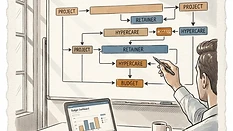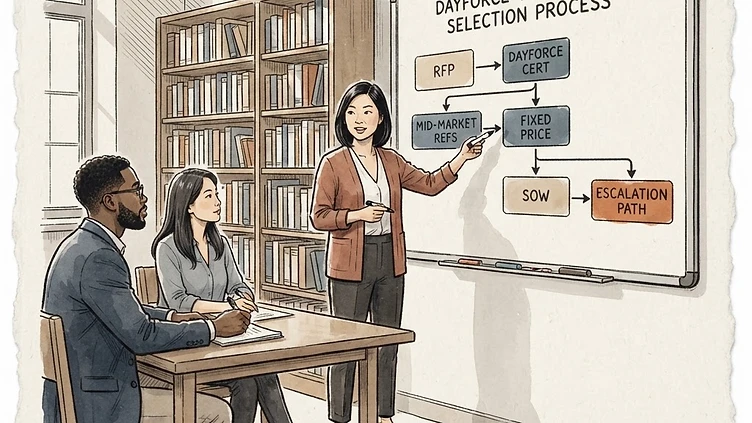
A Dayforce consultant is the person who decides whether your implementation actually works or quietly bleeds budget for two years. The wrong one configures around your problems, leaves at go-live, and bills you for the cleanup. The right one builds configuration that survives releases, trains your team, and leaves you owning the system.
If you're searching for a Dayforce consultant for a mid-market company (200–5,000 employees), the decision matters more than the platform you chose. Here's exactly what to screen for — and the questions that separate a real consultant from a billing resource.
Why most companies hire the wrong Dayforce consultant
The default move is to hire whoever the implementation partner assigns you. That person is often a generalist who's done a little of everything across several HCM platforms, rotated onto your project because they were available — not because they specialize in mid-market Dayforce.
The result is predictable: configuration built to get through go-live, not to last. Forms that break after the next release. Workflows no one documented. A system your team can't maintain because the consultant never trained them.
What a Dayforce consultant actually does
A Dayforce consultant isn't a project manager and isn't a support rep. Their job is configuration and system design — making Dayforce match how your organization actually operates across HR, payroll, benefits, time, and workforce management.
That means:
- Configuration — XML forms, workflows, pay codes, security roles, validation rules, business logic
- Integration design — SFTP, Integration Studio, API, carrier feeds, mapping data in and out
- Reporting — building the reports your finance and compliance teams actually need
- Data modeling — org structures, positions, pay groups, eligibility rules
- Module activation — turning on what you bought and making it work end-to-end
- Training and enablement — so your team can run the system after they leave
If someone calls themselves a Dayforce consultant but only does project management or ticket triage, they're not the person building your system.
The 7 questions to ask before you hire
1. How many mid-market Dayforce implementations have you personally configured?
Mid-market is a different animal than enterprise. The configuration patterns, the integration complexity, and the team size all change between 500 employees and 50,000. A consultant who's only done enterprise will over-engineer; one who's only done small business will under-build.
What you want to hear: specific numbers, specific company sizes, and the modules they personally configured — not "the team" configured.
2. Which Dayforce modules have you configured end-to-end?
A consultant who has only done Core HR and payroll will struggle when you ask them to finish benefits, performance, or compensation. "End-to-end" means they built it, tested it, and supported it through at least one live cycle — not that they watched someone else do it.
3. Can you show me a fixed-price scope for a defined piece of work?
This is the question that filters out time-and-materials billing. A real Dayforce consultant can scope a defined deliverable — rebuild a form, configure a workflow, build a report suite — and give you a fixed price. If every answer is "we'll bill hourly and see how it goes," you're buying an open checkbook.
4. What happens after go-live?
Need hands-on help with Dayforce?
Talk to our team →The first 90 days after go-live are where most Dayforce projects break — payroll hypercare failures, integration drift, configuration that worked in sandbox but breaks in production. Ask how they handle the transition from implementation to steady-state. Do they stay for hypercare? Do they train your team? Or do they roll off the day you go live?
5. Who actually does the work — you, or a junior resource you hand it to?
The senior consultant sells the deal; the junior consultant does the work. This is the oldest move in consulting. Ask who will be in your system every day, and whether the person you're talking to will be that person.
6. How do you handle Dayforce releases?
Dayforce updates change fields, behaviors, and form structures. Configuration that worked last year silently breaks after a release. A consultant who has a regression-testing plan — not just "we'll fix it when it breaks" — is one who's been burned before and learned from it.
7. Will my team be able to maintain this after you leave?
The right answer is yes, and they should be able to tell you how — job aids, train-the-trainer, documentation built into the engagement. The wrong answer is "we can keep you on retainer forever," which is a dependency, not a deliverable.
Dayforce consultant vs. Dayforce consulting firm
There's a difference between hiring an individual Dayforce consultant and hiring a Dayforce consulting firm. An individual gives you direct access to the person doing the work but has a single point of failure. A firm gives you bench depth but often puts a junior consultant on your project after the senior one sold it.
For mid-market companies, the sweet spot is a boutique firm small enough that the senior consultant is still the one in your system, but structured enough that you get documentation, a second set of eyes, and continuity if one person is out. That's the model Harmon & Co runs — and it's deliberately different from the large-partner rotation model.
Red flags that should end the conversation
- "We don't do fixed pricing." If they can't scope a defined deliverable, they're billing against you, not for you.
- No mid-market references. Enterprise logos don't prove they can handle your complexity at your size.
- The senior consultant disappears after the pitch. If you can't meet the person who'll be in your system, you won't know who is.
- No documentation or training in scope. A consultant who doesn't document is a consultant who wants you dependent.
- They generalize across five HCM platforms. Dayforce-only specialists know the platform deeper; generalists know it wider. For configuration depth, you want depth.
What fixed-price Dayforce consulting looks like
A fixed-price engagement starts with a scoped assessment — a short, paid discovery that maps what's built, what's broken, and what's missing. From there, each deliverable gets a price:
- Form rebuild — fixed scope, fixed price, tested against a real cycle
- Workflow configuration — defined approval chains, notifications, routing
- Report suite — the reports finance and compliance actually run
- Integration setup — SFTP or Integration Studio with defined endpoints
- Module completion — finishing what go-live left half-built
You pay for the outcome, not the hours. If the consultant underestimates, that's their margin problem, not your budget problem.
The bottom line
The Dayforce consultant you hire will spend more time inside your system than almost any other vendor. Screen for mid-market experience, Dayforce depth, fixed pricing, and a model that leaves your team capable — not dependent. Ask the seven questions above, and the right consultant will answer all of them with specifics. The wrong ones will change the subject.
Struggling with Dayforce Consulting?
Harmon & Co specializes in Dayforce consulting for mid-market companies. We fix it the first time — no endless ticket queue, no generic advice.